

W.A.A.S. Nexus: Cut Costs 20–40% Without Losing the Human Touch

What if you never had to choose between a leaner budget and a business your customers actually love? For too long, that felt like an impossible question. W.A.A.S. Nexus answers it by weaving together AI intelligence, human judgment, and community-rooted workers into a single, self-reinforcing model — one that trims costs without trimming the care your customers depend on.
The False Choice Hurting Business Owners Today
Walk into almost any conversation about cutting business costs and you’ll hear the same grim tradeoff: automate more, or pay more. Business owners are quietly told that leaner operations mean worse service, and that great service is a luxury reserved for those with deep pockets. That framing is not just discouraging — it’s wrong.
The real problem isn’t the cost of quality. It’s the structure that most businesses are running on. Legacy org charts were designed for a world before intelligent automation, before remote collaboration, and before the gig economy matured. Bolt AI onto that old structure and you get chaos. Ignore AI entirely and you fall behind on cost.
W.A.A.S. Nexus was built on a different premise: that AI, experienced human oversight, and hyperlocal workers are not competing options — they’re complementary layers. Stack them correctly and you don’t compromise on either efficiency or empathy. You get both. The three pillars of the Nexus model — A.L.I.A. Co-Pilot, Human-in-the-Loop oversight, and a community-based 1099 workforce — each solve a distinct problem, and together they make the false choice obsolete.
Pillar 1 — A.L.I.A. Co-Pilot: Your AI Consultant That Actually Listens
Most AI tools give you dashboards. A.L.I.A. Co-Pilot gives you direction.
Think of A.L.I.A. as a senior consultant who never sleeps, never bills by the hour, and never stops learning from your actual customers. It ingests real feedback — from support tickets, sales conversations, fulfillment data, and community signals — and continuously updates its recommendations so your services stay aligned with what the market actually needs right now, not what it needed last quarter.
Key capability: A.L.I.A. surfaces misalignments early — before they become refund requests, churn events, or reputation problems.
Where this gets powerful is in strategic clarity. Small and mid-sized business owners rarely have access to the kind of ongoing market intelligence that Fortune 500 companies buy on retainer. A.L.I.A. democratizes that intelligence. It flags when a service offering is drifting out of step with customer expectations, identifies patterns that a human analyst might take weeks to spot, and presents recommendations in plain language that doesn’t require a data science degree to act on.
The result is a leaner decision-making process. Fewer expensive gut-check meetings. Faster pivots. And a business that feels intuitively in tune with its customers — because it genuinely is.

Pillar 2 — Human-in-the-Loop: Smart Structure That Trims the Fat, Not the Care
Automation without accountability is how businesses lose the trust they spent years building. That’s the risk every operator takes when they hand too much over to a machine. Human-in-the-Loop (HITL) oversight is how W.A.A.S. Nexus avoids that trap.
The HITL framework is simple in concept: let AI handle the routine, and let experienced humans own the moments that matter most. Appointment confirmations, intake routing, standard follow-up sequences — AI manages these with speed and consistency. But a customer in distress, a complex fulfillment issue, an edge case that doesn’t fit the script? A trained human steps in, every time.
This isn’t just good ethics. It’s good economics. By structuring roles around where human judgment genuinely adds value — rather than having people manually manage tasks that software handles better — businesses eliminate redundant layers and unnecessary overhead. That structural efficiency is the primary driver behind the 20–40% cost reduction the Nexus model delivers.
Consider what gets cut:
– Supervisory roles that exist only to monitor routine processes
– Quality-check layers that AI-driven consistency makes redundant
– Escalation chains that were designed to compensate for unreliable automation
What doesn’t get cut is accountability, empathy, or the human voice your customers trust. The HITL layer ensures those qualities are preserved precisely because they’re protected — reserved for the interactions where they make the most difference.
Pillar 3 — Hyperlocal 1099 Workers: Community Roots With Career Upside
The third pillar is the one that connects your business to the neighborhood it serves.
W.A.A.S. Nexus partners with fair-wage local contractors — independent 1099 workers — who handle Sales, Marketing, Fulfillment, and Customer Support. These aren’t anonymous gig workers picking up shifts between apps. They’re community members with a genuine stake in the businesses they represent and a structured path to grow their careers within the ecosystem.
The model uses a gamified, skills-building framework that rewards performance, loyalty, and upskilling. Workers earn recognition and advancement opportunities as they develop expertise — which means the people serving your customers are motivated to get better, not just to clock out.
Why does this matter for your bottom line?
| Traditional Workforce Model | W.A.A.S. Nexus 1099 Model |
|---|---|
| High turnover, constant retraining | Career-owned path reduces churn |
| Benefits overhead per FTE | Contractor structure trims fixed costs |
| Generic service delivery | Local knowledge improves customer fit |
| Workers disconnected from brand outcomes | Gamified incentives align effort with results |
Beyond the numbers, there’s a community dimension that has real business value. A local worker who lives two blocks from your customer doesn’t just deliver a package — they represent your brand in the grocery store, at the school pickup, at the neighborhood block party. That kind of embedded presence builds the kind of trust that no ad campaign can buy.
How the Three Pillars Work Together in Practice
Let’s make this concrete. Here’s what a single day might look like inside a W.A.A.S. Nexus-powered operation.
Morning: A.L.I.A. Co-Pilot flags an uptick in support contacts mentioning a specific service delay. It cross-references fulfillment data, identifies a workflow bottleneck, and surfaces a recommended adjustment — all before the first human manager logs on.
Midday: The HITL oversight team reviews A.L.I.A.’s flagged cases. Routine rescheduling is already handled automatically. The two cases that involve frustrated repeat customers are routed to experienced human agents, who resolve them with context and care. The fix to the bottleneck is approved and pushed to the local fulfillment team.
Afternoon: Local 1099 workers execute the adjusted fulfillment workflow, delivering with the neighborhood familiarity that makes customers feel seen rather than processed. One worker notices a new business opening two doors down and flags it as a potential sales lead through the platform. A.L.I.A. logs it.
Each pillar amplifies the others. A.L.I.A. catches what humans would miss at scale. The HITL layer ensures no AI decision goes unreviewed where it counts. Local workers provide the on-the-ground intelligence that keeps the whole system grounded in reality. Remove any one leg and the stool wobbles. Together, they create a seamless operation that delivers better outcomes at lower cost.
The W.A.A.S. Nexus Flywheel: Better Service Builds a Smarter Business
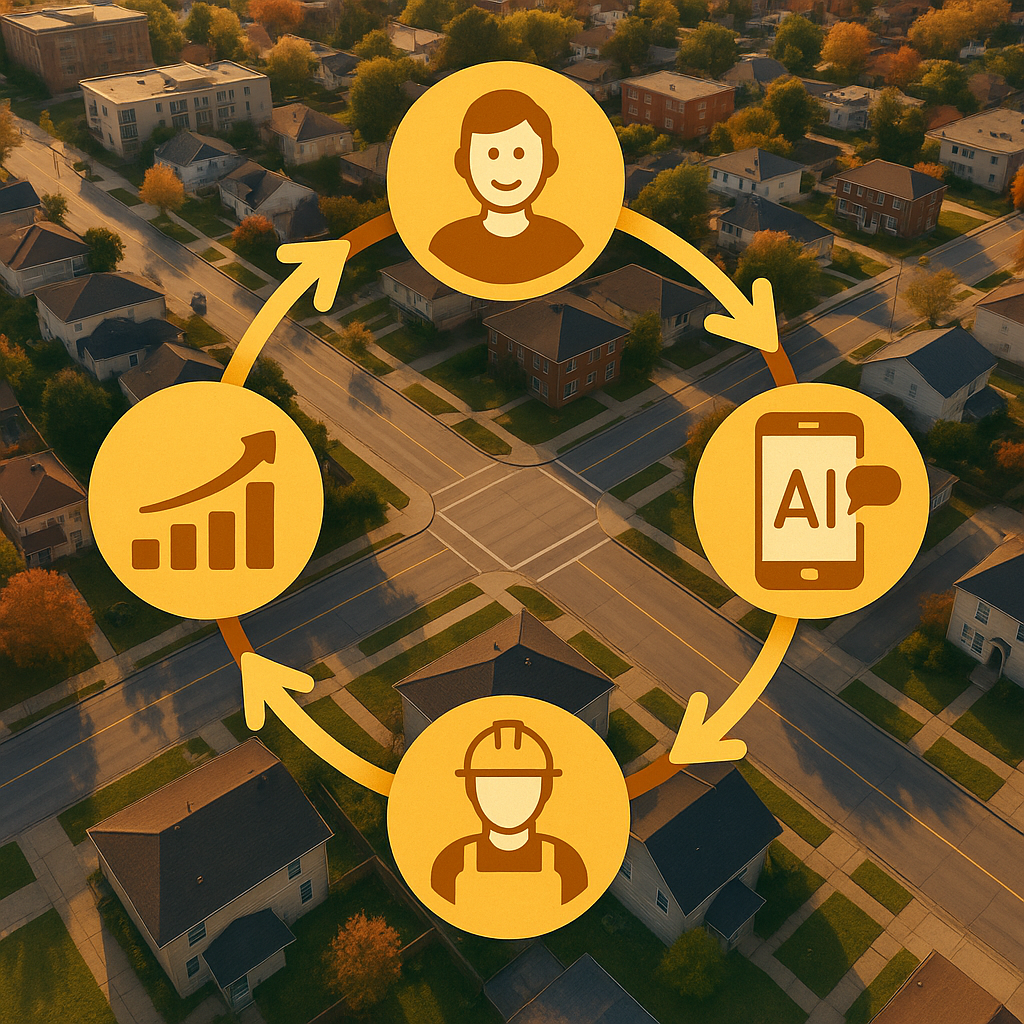
This is where the model becomes more than efficient — it becomes self-reinforcing.
Better service wins more customers. More customers generate richer interaction data. Richer data makes A.L.I.A. smarter and more precise in its recommendations. A smarter A.L.I.A. improves every pillar — tightening the HITL workflow, upskilling local workers faster, and surfacing new market opportunities sooner. Which delivers even better service.
The flywheel effect means early adopters compound their advantage over time. The longer the system runs, the sharper it gets — and the harder it becomes to replicate from the outside.
For Business Service Providers evaluating a next-generation workforce model, this is the strategic case: W.A.A.S. Nexus doesn’t just cut costs today. It builds a smarter, more community-connected business that gets better every quarter without proportionally increasing overhead.
The 20–40% cost reduction is the headline. The compounding intelligence and community loyalty are the real story.
Get in Touch
If you’re a business owner or BSP ready to explore what W.A.A.S. Nexus could look like for your operation, we’d love to start the conversation. Whether you’re looking to reduce overhead, build stronger community ties, or simply understand how AI and human teams can work better together — our team is here to walk you through it.
Reach out today to schedule a no-pressure discovery call and see how the three-pillar model maps to your specific business.
Disclaimer: Cost reduction ranges of 20–40% are based on modeled projections and may vary depending on business size, industry, existing infrastructure, and implementation scope. W.A.A.S. Nexus does not guarantee specific financial outcomes. All references to A.L.I.A. Co-Pilot capabilities reflect current platform features, which are subject to ongoing development. Independent contractor arrangements are subject to applicable federal, state, and local laws. Consult qualified legal and financial advisors before making workforce or operational changes.
Leave A Comment